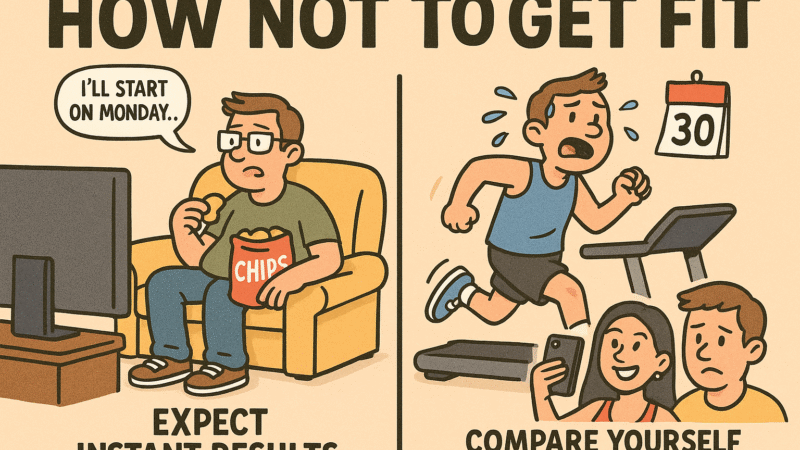
How NOT to Start Running (And Hate Every Second of It)

Running is simple. Humans are complicated. That’s why beginners accidentally turn running into misery and then conclude: “I guess I’m not a running person.”
Welcome to How NOT to Start Running: a lovingly sarcastic guide to sabotaging yourself—followed by tiny fixes that keep you alive, consistent, and oddly proud of your legs.
1) Sprint on day one (to prove you’re serious)
Nothing says “new hobby” like going full Olympic qualifier for 47 seconds, seeing a bright light, and then walking home in shame like you just lost a fight to oxygen.
If your first run feels like punishment, your brain will file “running” under avoid forever. Which is a shame, because you didn’t fail running—you just attempted the Boss Level on day one.
Do instead: start embarrassingly easy. Run/walk intervals. A good first session should feel like: “Wait, that’s it?”
2) Run every day because motivation is a renewable resource
Motivation is not renewable. Knees are also not renewable. Your shin bones would like to opt out of your new “daily grindset.”
Beginners often confuse enthusiasm with capacity. You can be excited and still need recovery. Your body adapts on rest days—like a superhero, but slower and with more stretching.
Do instead: 3 days/week is plenty. Treat rest as training, not laziness.
3) Start with the hardest route you can find
Hills are great—once you can run more than your phone’s Face ID unlock time. Starting on hills is basically choosing suffering as your brand.
Also, wind matters. So does heat. So does choosing a route with three traffic lights and a dog that hates you.
Do instead: start flat, predictable, and safe. Save hills for later when your calves stop filing complaints.
4) Wear whatever shoes you found near the door
Ah yes, the ancient running tradition of “I’ll just use these old shoes from 2014.” Bonus points if they’re fashionable but feel like two bricks taped to your feet.
Bad shoes don’t just feel uncomfortable—they can make everything hurt in creative new places. Running is hard enough without adding “foot pain side quest.”
Do instead: one decent pair of running shoes. That’s it. You don’t need a watch that costs more than your rent.
5) Ignore pain because you saw a motivational quote once
There’s a difference between “this is hard” and “this is injury.” Your body will inform you. Loudly. And usually at the worst time.
If something hurts sharply, changes your gait, or sticks around for days, that’s not “weakness leaving the body.” That’s your body asking for a meeting.
Do instead: back off, rest, and adjust. Progress doesn’t count if you’re limping.
6) Treat every run like a test you must pass
When every run is a performance review, you’ll eventually fail one (because life happens), and then you’ll quit out of spite.
Running is not a personality. It’s a habit. Habits don’t require perfection; they require repetition.
Do instead: aim for “show up” runs. Some runs are slow. Some are short. Some are just you proving you still exist. All count.
A beginner plan that doesn’t ruin your week
This is the “I want to improve without hating my life” plan:
- 3x/week (e.g., Mon/Wed/Sat)
- 20–30 minutes total
- Run 1 minute / walk 2 minutes, repeat
- After 2 weeks: increase run time slowly (like 15–30 seconds at a time)
Micro-checklist (before every run)
- Easy pace (you should be able to talk)
- Short warm-up (5 minutes walk)
- Stop before you’re destroyed
- Hydrate and move on with your day like a normal person
Conclusion
Starting running isn’t about proving toughness. It’s about showing up repeatedly at a level that feels almost too easy.
The goal is to finish thinking: “I could do that again.” Because that’s how you actually become a runner—quietly, repeatedly, and with fewer dramatic lung incidents.